

Visit our photo galleries - photos.fsexpeditions.com

Browse our 2010 Online Digital Catalog | Fantastico Sur Expeditions, the Local Experts for your Patagonia & Chile Nature Journeys

Browse our Online Digital Catalog here or use the link below to request our new 2013 catalog which will be out by May 2012!

Request Catalog

Pay by credit card using our secure payment system powered by WebPay Plus

For your convenience, all our tours can be paid with credit card, using our secure payment system and with no extra charges.

Want to be a fan? Join our Facebook page! Join our Youtube Channel! Keep updated by checking our nature and travel tweets Visit our Flickr photo galleries


Claudio F. Vidal


2012.05.08 19:57:11

The Snowy Sheathbill (Chionis alba) is an odd-looking Antarctic seabird; it belongs to the small family Chionidae, which comprises only two sheathbill species, both occurring in the Southern Ocean.
This scavenging bird primarily feeds around penguin and other seabird breeding colonies as well as seal rookeries. During the winter migrates from the Antarctic Peninsula northwards to the coasts of Patagonia and Tierra del Fuego.
This tame individual was shot near the ferry crossing of Punta Delgada in the Straits of Magellan in late April.
Small numbers of non-breeding birds remain year-round in the coasts of Patagonia and the Falkland (Malvinas) Islands.


Snowy Sheathbill (Chionis alba), Magellan Straits, Chile © Claudio F. Vidal - www.fsexpeditions.com
 

La Paloma Antártica (Chionis alba) es una extraña ave marina de origen Antártico; pertenece a la pequeña familia Chionidae que comprende sólo dos especies, ambas habitantes exclusivas del Océano Austral.
Esta ave carroñera se alimenta principalmente alrededor de colonias de pingüinos y de otras aves marinas, así como en colonias de lobos y elefantes marinos. Durante el invierno migra desde la Península Antártica hasta las costas de Patagonia y Tierra del Fuego.
Este manso individuo fue fotografiado en las cercanías del cruce de Punta Delgada en el Estrecho de Magallanes, a fines de Abril.
Pequeños números de individuos no-reproductivos permanecen en las costas Patagónicas e Islas Malvinas durante todo el año.

© Claudio F. Vidal 2012


Tags:


2012.04.10 03:59:10

'Motu Kao Kao', the largest of the three volcanic islets located in the south-western corner of Rapa Nui - a paradise for the pelagic birder © Claudio F. Vidal - www.fsexpeditions.comChile's offshore waters are known to be as one of the most productive oceanic regions on Earth, and you can prove this by taking a short pelagic trip off Valparaiso (or Quintero), where you are likely to encounter a myriad of tubenoses and other seabirds occurring in the cold-and-rich Humboldt Current, which flows along almost the entire length of Chile and continuing north towards Peru and Ecuador.


Chile has other offshore island dependencies which are truly excellent for pelagic birding. The Juan Fernandez Archipelago and its three associated islands (including the 'Robinson Crusoe'), is one of them. Also the 'Desventuradas' Islands (San Felix and San Ambrosio)... but that's another story! Probably, the least known of Chile's pelagic hotspots is 'Rapa Nui' (or Easter Island, which was the name given by the Europeans who 'discovered' it in 1722).


Rapa Nui - this seemingly barren, triangular, volcanic rock, lying in the middle of the Pacific Ocean, is readily accessible from Santiago de Chile, with many flights a week. Hundreds, and even thousands of tourists, focus their limited time in the island and visit the enigmatic giant stone statues (known as 'moai') which were carved during the centuries by the early and skilled inhabitants of the island.


The magnificent moai at Ahu Tongariki, Rapa Nui [Easter Island] © Claudio F. Vidal - www.fsexpeditions.com


Dark and light morphs of Kermadec Petrel (Pterodroma neglecta), off Easter Island, Chile © Claudio F. Vidal - www.fsexpeditions.com Rapa Nui was once an island completely covered by palm trees and many landbirds were part its rich biodiversity inventory. The further environmental collapse caused by its inhabitants, as a result of centuries of deforestation and natural resources depletion, eventually led to the total extinction of all the landbirds and even the majority of its seabird colonies.


The 'motus', as the locals called the small volcanic islets located in the south-western corner of the island, hold an outstanding number of pelagic birds; these 'motus' are likely to be one of the easiest places on Earth where you can find up to five Pterodroma or 'gadfly' petrels. The easiest and most common are the stockily-built Kermadec Petrel and the elegant Herald Petrel; the islets also hold small numbers of Phoenix Petrel, the newly-discovered Murphy's Petrel (which breed in the main island too) and the recently-split Henderson's Petrel (formerly considered the dark morph of Herald Petrel). 


Other interesting seabirds occurring in the 'motus' as well as on the main island are the Red-tailed Tropicbird and White-tailed Tropicbird, the Great Frigatebird, the Masked Booby, the Grey Ternlet, the scarce Sooty Tern, the Grey Noddy, and the Christmas Shearwater.


Dark morph of Kermadec Petrel (Pterodroma neglecta), off Easter Island, Chile © Claudio F. Vidal - www.fsexpeditions.com


Over the years, we have been taking many visitors to these little volcanic islets, and we can conclude that this is truly a fantastic and unpassable experience for the seabirder. We normally circumnavigate the islets during the late afternoon, when the birds are coming back from the ocean to their breeding grounds, consisting of burrows, ledges and crevasses. At times the sea conditions prevent the departure of our sea trips (due to safety issues); but to live this experience is worthwhile to spend some extra couple of days in the island, just in case the sea keep unsettled.


Pelagic seabirding at Easter Island - March 2012 © Claudio F. Vidal - www.fsexpeditions.com


The island still keeps many secrets, and not just for the archaeologist... These enigmatic and unknown seabirds can reveal more details to us about their feeding and breeding ecology, distribution range and population dynamics. On one of our early trips, our leader Enrique Couve did find the first documented record of Murphy's Petrel, as he was watching 'this dark-and-strange' petrel flying over the 'quarry of the hats' - one of the archeological sites of the main island. Now, the breeding of this seabird on Rapa Nui has recently been proven.    


Light morph of Herald Petrel (Pterodroma heraldica), off Easter Island, Chile © Claudio F. Vidal - www.fsexpeditions.com


Join us on one of our exciting journeys of discovery to this enigmatic island of Polynesia and discover its unknown and seldom-seen seabirds with us. Trip details of our trip to Rapa Nui (Easter Island) here.


Related subjects:

• A comprehensive article on the Birds of Easter Island by Alvaro Jaramillo. Click here.

• Our blog entry with the first notes on our sighting of Murphy's Petrel (Pterodroma ultima) on Easter Island. Read here.


Tags:


2012.04.09 22:01:49

A single individual of Little (Subantarctic) Shearwater - Puffinus [assimilis] elegans - was photographed off the western coast of Chiloé Island (one nautical mile nw of Metalqui islet - 42°11'47.61"S • 74°10'27.21"W) on 21 February 2012 (11.10am). 

Observers: Claudio F. Vidal, Mike Thompson & Susie Pearson.

Photos: © Claudio F. Vidal, FS Expeditions. Fore more photos please check the following link


Records of Little (Subantarctic) Shearwater off Chiloe Island, southern Chile © Photos by Claudio F. Vidal, FS Expeditions - www.fsexpeditions.com


Records of Little (Subantarctic) Shearwater off Chiloe Island, southern Chile © Photos by Claudio F. Vidal, FS Expeditions - www.fsexpeditions.com


Records of Little (Subantarctic) Shearwater off Chiloe Island, southern Chile © Photos by Claudio F. Vidal, FS Expeditions - www.fsexpeditions.com


Tags:


2012.04.02 16:32:08


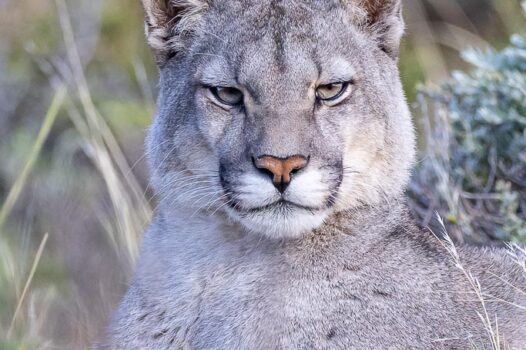
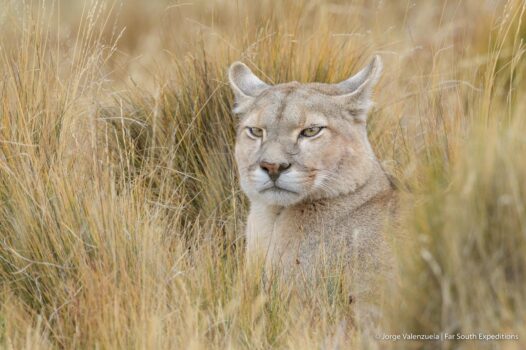
There is something very special and rewarding when you are fortunate enough to see a big cat in the wild, and Pumas are a perfect example of this feeling, a real priviledge for the nature enthusiast. 

The last fire of December 2011 / January 2012, which was produced by a negligent and irresponsible visitor to this magnificent national park of southern Chile, caused significant damage and devastation to its native vegetation and variety of habitats. You can readily see the fire effects on the plant communities but you soon start to wonder 'what are the real effects to the life cycles of the animals, particularly the park's apex predator', the magnificent Puma (Puma concolor patagonica). 

Pumas are lonely hunters on these vast domains, preying primarily on the ubiquituous camel-like Guanaco and the introduced European Hare. The pastures of these two herbivores were affected by the fire and consequently the feeding grounds and territories of many individual Pumas were disturbed. 


puma-torres-del-paine-chile_-2


Pumas, both males and females, are highly territorial and they do move considerably within the boundaries of their feeding grounds, looking for prey and actively marking with scent the extent of their domains.

Recently, several pumas have been seen 'wandering' from fire-affected areas into hunting territories of other well-established cats, and consequently this re-arranging of overlapping territories, will mean eventually some disputes and can even affect the reproduction success of several females.


puma-torres-del-paine-chile_-3


During the last week of March 2012, we had the great priviledge of seeing Puma during two of of our mammal-oriented tours, operated for renowned nature companies (1, 2). A young female, in particular, with its three-month old cub at the shores of the huge Sarmiento Lake, caught our fascination. This lovely female looked at excelent condition as its sole litter. They were both seen during consecutive days feeding on a fresh kills, consisting on a large-sized guanacos. Other pumas, mostly males, were spotted at different corners of the park, as far south a Paine River near Lago Toro.


puma-torres-del-paine-chile_-8


Our main concern is the lack of current long-term research on the population dynamics of these charismatic cats and the immediate effects caused by the fire on their diet and reproduction success. We urge park authorities and conservation organizations in setting up research and conservation initiatives in the near future; as a company we would be delighted and very committed to support scuh studies.


puma-torres-del-paine-chile_-9


Tags:


2012.03.08 23:34:12

Southern River Otter (Lontra provocax) - locally known as Huillin - an endangered mustelid of southern Chile.

This splendid shot was taken on 19 February 2012 by guest Abraham Varguese during our recent tour 'Mammals & Birds of Patagonia'. — Chepu River, Chiloé Island, southern  Chile.


Southern River Otter / Huillin (Lontra provocax), Chiloe Island, Chile


Tags:


Page 1 of 11
«StartPrev12345678910NextEnd»
banner_turistas01.jpg